What is data management (and why it’s the ROI multiplier)?
Before the tech stack, anchor the definition.
IBM defines data management as the practice of collecting, processing, and using data securely and efficiently for better business outcomes. (
IBM)
DAMA adds an enterprise lens: data management spans plans, policies, programs, and practices that protect and enhance the value of data assets across their lifecycle. (
DAMA International®)
That’s the point: ROI doesn’t come from “having a platform.” It comes from managing data as an asset—so it can be activated reliably across teams, clouds, and use cases.
The story: how Customer 360 ROI breaks (and how to fix it)
Most Customer 360 programs under-deliver for four predictable reasons:
-
Data is stale (batch ETL, delays, duplication)
-
Identity is messy (duplicates, false merges, inconsistent keys)
-
Governance is inconsistent (policies don’t follow data into activation)
-
Activation is manual (handoffs, spreadsheets, one-off segments)
Salesforce’s positioning for Data 360 is to “turn existing data into action instantly, without moving it,” enabling connected profiles across marketing, sales, service, and commerce. (
Salesforce)
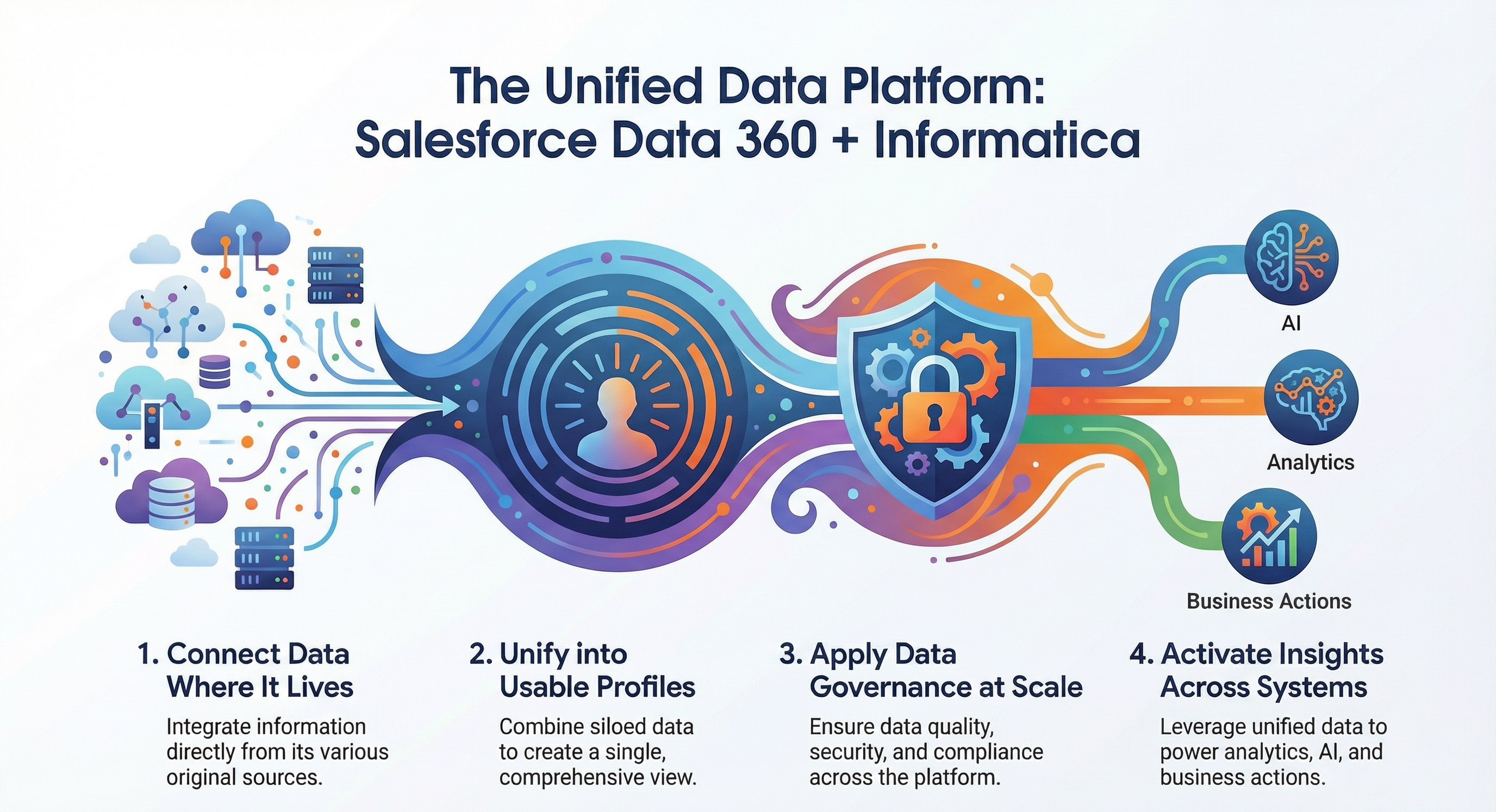
The fix is a structured path:
connect → harmonize → govern → activate → measure.%20-%20visual%20selection-1.png?width=2736&height=1634&name=The%20story_%20how%20Customer%20360%20ROI%20breaks%20(and%20how%20to%20fix%20it)%20-%20visual%20selection-1.png)
What Salesforce Data 360 provides (mapped to measurable ROI)
1) Connect: Zero Copy integration + broad connectivity
Salesforce describes Zero Copy Data Federation as access to data in external platforms like Snowflake, BigQuery, Databricks, and Amazon Redshift from Data Cloud—without creating copies. (
Salesforce)
Salesforce also highlights enterprise interoperability across Salesforce and external data lakes/warehouses as a core architectural theme. (
Salesforce Architects)
Informatica’s role: establish repeatable connectivity and onboarding patterns across AWS/Azure and hybrid sources, while enforcing consistent definitions and quality checks as data enters the activation layer. (
Informatica)
2) Harmonize: unified data + identity resolution into a Customer 360
Salesforce explains that identity resolution consolidates data from different sources using matching and reconciliation rules to create unified profiles that include contact point values from all sources. (
Salesforce)
Trailhead notes unified profiles are mutable and update as source data or identity rules change. (
Trailhead)
Informatica’s role: improve match outcomes with standardization, deduplication, and survivorship patterns—so the “unified data” is accurate enough to drive targeting and automation at scale.
3) Govern: policy-based data governance that survives activation
Salesforce’s Data 360 Governance emphasizes automated tagging/classification of
unified data and metadata to drive
policy-based governance across use cases. (
Salesforce)
Salesforce also announced Data Cloud Governance GA with “native, consistent policy enforcement” for the AI era. (
Salesforce)
Salesforce documentation describes how tagging and classification links policies to tags so enforcement scales as data grows. (
Salesforce)
Informatica’s role: broaden governance beyond one platform with catalog + governance workflows and data quality context (e.g., Informatica Cloud Data Governance and Catalog combines governance, catalog, and quality capabilities). (
Informatica)
4) Activate: segments + triggered flows + data sharing back out
Salesforce positions Data 360 for real-time activation—connected profiles and real-time activation across channels. (
Salesforce)
Its “Zero Copy and Sharing” materials explicitly pair federation (data-in) with data sharing back to external platforms. (
Salesforce)
Informatica’s role: maintain trust and operability as activation scales (quality thresholds, lineage awareness, change impact analysis, stewardship workflows).
%20-%20visual%20selection%20(2).png?width=2574&height=1239&name=What%20Salesforce%20Data%20360%20provides%20(mapped%20to%20measurable%20ROI)%20-%20visual%20selection%20(2).png)
Structured data vs unstructured data (and why it changes your ROI plan)
If your 2026 roadmap includes agents, search, or personalization, you can’t ignore unstructured content.
Salesforce notes that unstructured data can include emails, social posts, web pages, and multimedia like images/audio/video, while structured data uses defined schemas and is ingested via Data Lake Objects (DLOs) and Data Streams. (
Salesforce)
Practical takeaway for IT leaders:
-
Start ROI with structured data (profiles, transactions, consent, service events) because KPIs are easier to measure.
-
Add unstructured data when you have clear use cases (sentiment, case summaries, knowledge grounding) and governance controls ready.
Examples of metadata (why “metadata-driven” matters for governance)
Salesforce Architects describes Data 360 as metadata-driven, which is a big deal for governance and scale. (
Salesforce Architects)
Microsoft’s Cloud Adoption Framework breaks metadata into:
Why this matters for ROI: good metadata reduces time-to-troubleshoot, improves audit readiness, and makes policy enforcement practical—not manual.
The ROI model: 4 levers you can measure in dollars and hours
.png?width=2959&height=1378&name=The%20ROI%20model_%204%20levers%20you%20can%20measure%20in%20dollars%20and%20hours%20-%20visual%20selection%20(1).png)
Lever 1 — Cost avoidance (reduce duplication + pipeline sprawl)When Zero Copy is appropriate, you can reduce replicated datasets and retire redundant pipelines. (
Salesforce)
Measure: pipelines retired, TB duplication avoided, compute/runtime reductions.
Lever 2 — Speed-to-activation (shorten time-to-value)
Data 360’s “unify and act” framing is explicitly about accelerating activation from unified data. (
Trailhead)
Measure: time from data request → segment/flow live.
Lever 3 — Revenue lift (better targeting + better service decisions)
Unified profiles + segments enable more precise activation across channels. (
Salesforce)
Measure: conversion lift, churn reduction, cost-to-serve improvements tied to specific segments/workflows.
Lever 4 — Risk reduction (governance coverage and policy enforcement)
Data Cloud Governance GA emphasizes governing data at scale for the AI era. (
Salesforce)
Measure: % sensitive fields tagged/classified, policy violations prevented, audit cycle time.
Mini runbook: a 90-day plan to prove ROI (without boiling the ocean)
Phase 1 (Weeks 1–2): Define the ROI thesis + baseline
-
Pick 2 use cases with measurable impact (e.g., churn prevention + service deflection)
-
Baseline: time-to-activate, data freshness, identity quality, governance coverage
Phase 2 (Weeks 3–6): Connect the minimum viable dataset footprint
Informatica’s role: implement repeatable ingestion/federation patterns, data quality gates, and catalog visibility to prevent “one-off pipelines” from multiplying. (
Informatica)
Phase 3 (Weeks 7–9): Harmonize identity into unified profiles
Phase 4 (Weeks 10–13): Apply governance, activate, and measure
%20-%20visual%20selection-1.png?width=3204&height=1480&name=Mini%20runbook_%20a%2090-day%20plan%20to%20prove%20ROI%20(without%20boiling%20the%20ocean)%20-%20visual%20selection-1.png)
The KPI set: 5 metrics that make ROI undeniable
-
Time-to-activate: dataset → segment/flow live
-
Data duplication avoided: TB avoided + pipelines retired
-
Identity resolution quality: match rate + sampled false merge rate (
Salesforce)
-
Governance coverage: % sensitive fields tagged/classified + policy enforcement coverage (
Salesforce)
-
Outcome KPI: conversion lift / churn reduction / service cost reduction tied to the activated segment
Common pitfalls (and how to avoid them)
Analyst insights (proof points that align with this approach)
-
Gartner: Gartner’s 2025 D&A predictions highlight AI agents augmenting/automating decisions and governance risks if data practices don’t keep up.
What it means: governance and activation aren’t “nice to have”—they’re prerequisites for safe scale. (
Gartner)
-
McKinsey: McKinsey’s State of AI notes many orgs still haven’t embedded AI deeply enough into workflows to realize material enterprise impact.
What it means: the fastest returns come from operationalizing trusted data into repeatable processes (segments + workflows), not endless pilots. (
McKinsey & Company)
-
IDC: IDC’s FutureScape framing emphasizes unstructured data, AI agents, and unified governance as AI adoption grows.
What it means: structured + unstructured data strategies need a shared governance foundation. (
IDC)
-
Forrester: Forrester highlights continued enterprise interest and maturation in CDPs, reinforcing that the “long game” is making unified customer data operational.
What it means: success shifts from “owning a platform” to proving identity quality, governance, and activation outcomes. (
Forrester)
If you want a 90-day ROI plan tailored to your environment—Salesforce Data 360 (data cloud) connected to Snowflake/Databricks/BigQuery across AWS/Azure—request a working session. We’ll help you baseline KPIs, choose Zero Copy vs ingestion, and design a governance-first activation path.






.png@width=352&name=unnamed (1).png)