
Introduction
Most customer organizations still operate in a reactive model. A case gets opened. Usage drops for weeks before someone notices. Renewal risk appears too late. Expansion opportunities remain buried in product telemetry, service history, billing data, or asset systems.
That is not usually a CRM problem. It is an architecture problem.
When customer data is spread across service platforms, product systems, ERPs, support tools, and event streams, Salesforce users do not get the full picture in time to act. Salesforce defines a unified customer profile as a comprehensive view built from every interaction across online and offline systems, harmonized in real time to support insight and personalization. (Salesforce)
For IT leaders in North America, the opportunity is clear: build a unified customer data layer that helps the business move from reactive support to proactive engagement.
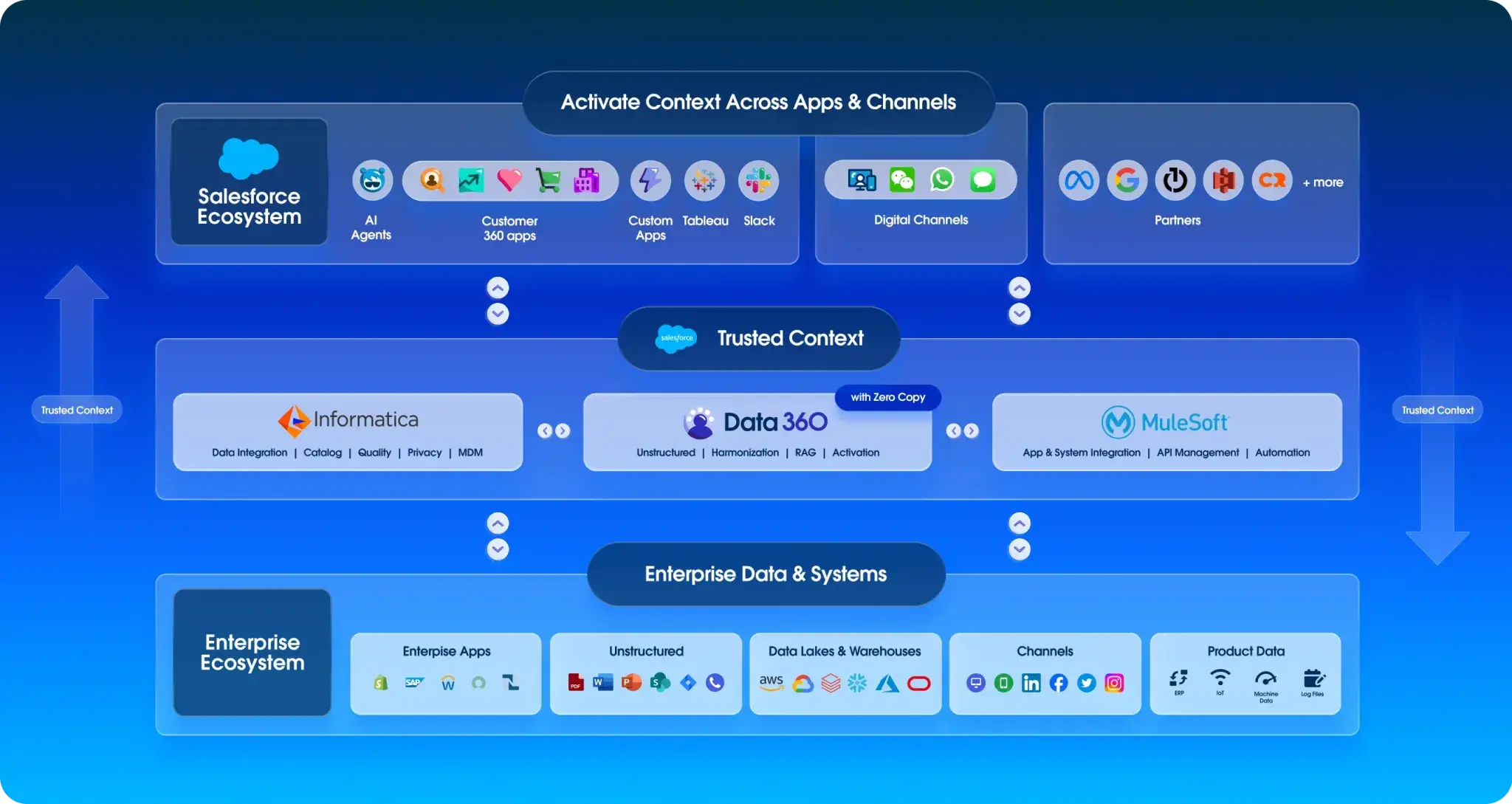
Pacific Data Integrators’ modern customer engagement architecture for delivering a unified customer experience
PDI helps organizations turn customer engagement into a connected, intelligent operating model by bringing together the four layers that matter most: a strong customer data foundation, trusted and governed enterprise data, real-time integration, and automation-driven action. By combining Salesforce Data 360 for unified customer insight, Informatica for data quality, governance, and master data, MuleSoft for real-time connectivity across systems, and Agentforce for intelligent automation and next-best-action execution, PDI enables clients to detect signals faster, make better decisions, and activate the right customer response in real time.
1. Building a stronger customer data foundation
At PDI, we help organizations unlock the full value of Salesforce Data 360 by creating a unified customer data foundation that brings together information from across the enterprise. This enables a single, connected view of the customer and supports real-time insights that power more personalized, relevant, and timely engagement.
2. Establishing trusted and governed enterprise data
Customer engagement is only as effective as the data behind it. PDI helps clients strengthen data trust through Informatica master data management, data quality, and governance capabilities, ensuring that unified customer profiles are accurate, consistent, and business-ready. With trusted and governed data, organizations are better positioned to improve decision-making, reduce risk, and prepare for AI-driven use cases.
3. Enabling real-time integration and event flow
Modern customer experiences depend on systems working together in real time. PDI leverages MuleSoft to connect Salesforce with enterprise applications, data sources, and devices, enabling seamless data movement and event-driven interactions across the ecosystem. This allows organizations to respond to customer signals as they happen, rather than after the fact.
4. Automation and actioning
PDI helps clients move from insight to action by enabling Salesforce Agentforce and related automation capabilities across channels, workflows, and business processes. By connecting intelligence with operational workflows, organizations can deliver next-best actions, streamline service and engagement processes, and create faster, more consistent customer responses.
Bringing it all together
By combining Salesforce Data 360, Informatica, MuleSoft, and Agentforce, PDI helps organizations build a more connected and intelligent customer engagement operating model. The result is an ecosystem that can detect signals, determine what matters, and activate the right response quickly and at scale.
At PDI, we see these four layers not as separate technologies, but as a unified framework for modern customer engagement—one that helps organizations move from fragmented data and disconnected systems to real-time, trusted, and actionable customer intelligence.
Why proactive customer engagement matters now
IT teams are increasingly being asked to support outcomes, not just uptime. Customer success, service, sales, and operations all want earlier visibility into churn risk, adoption issues, and growth potential.
That shift matches how leading analysts describe modern engagement. IDC argues that CRM is moving toward real-time, contextualized data, cross-functional collaboration, and AI-enhanced automation that reduces silos. McKinsey similarly links personalization and next-best-experience models to stronger loyalty, repeat engagement, and revenue lift. (IDC)
In practice, proactive engagement often starts with signals such as:
-
declining usage
-
underused assets or entitlements
-
renewal timing
-
spikes in service activity
-
billing or operational anomalies
-
stalled onboarding or adoption milestones
-
churn rate by segment
-
gross and net revenue retention
-
customer lifetime value
-
time from signal detection to action
-
expansion pipeline influenced by proactive plays
-
CIOs and enterprise architects modernizing customer engagement stacks
-
CRM and data platform leaders responsible for Salesforce strategy
-
IT leaders supporting customer success, service, renewals, or digital operations
-
teams evaluating how to connect data governance, integration, and AI-driven actioning
The technical challenge is not identifying these signals conceptually. It is connecting the systems where those signals live and turning them into action inside Salesforce quickly enough to matter.
How Informatica, MuleSoft, and Salesforce fit together
A practical reference architecture looks like this:
Salesforce Data Cloud / Data 360
Acts as the engagement-facing data foundation, helping unify profiles and support real-time insights. (Salesforce)
Informatica
Improves trust in the data that feeds that foundation through MDM, customer 360, governance, cataloging, and quality processes. Informatica’s Customer 360 and MDM messaging centers on a single trusted customer view and governed sharing of customer data. (Informatica)
MuleSoft
Connects the operational systems, APIs, and event streams that keep customer signals fresh. MuleSoft explicitly frames its platform around connecting Salesforce with any system and enabling event-driven architectures for real-time experiences. (Mulesoft)
Agentforce and workflow automation
Takes the resulting signal and context and turns it into action, whether that means proactive outreach, guided resolution, or contextual upsell recommendations. Salesforce describes Agentforce as acting across channels and systems using existing workflows and integrations. (Salesforce)
This is the gap many enterprises still need to close. Salesforce can be the engagement system, but it performs best when the surrounding data, governance, and integration layers are mature enough to support continuous decisioning.
PDI Mini runbook: how to roll out a proactive engagement model
Checklist for IT leaders
1. Prioritize 3-5 high-value signals
Start with a narrow set of business events such as renewal risk, declining usage, service spikes, or expansion triggers.
2. Map the systems of record
Identify where each signal originates: product telemetry, ERP, support platform, billing, installed base, subscription systems, or data warehouse.
3. Define trust rules
Use governance, identity resolution, and data quality rules so the business is not acting on duplicates, stale records, or conflicting account hierarchies. (Informatica)
4. Connect real-time data flows
Use APIs, events, and integration patterns to move critical signals into the engagement layer fast enough for service, sales, or success teams to use them. (Mulesoft)
5. Design next-best actions
Define what should happen when a signal appears: create a task, route to a team, launch outreach, surface guidance, or trigger an agentic workflow. (Salesforce Admins)
6. Measure business outcomes, not just pipelines
Tie architecture changes to churn, retention, expansion, and service efficiency.
KPIs to track
-
churn rate by segment
-
gross and net revenue retention
-
customer lifetime value
-
time from signal detection to action
-
expansion pipeline influenced by proactive plays
Common pitfalls
Treating Data Cloud as a standalone fix- A customer data platform helps, but fragmented source systems, weak governance, and slow integration still limit value. Salesforce, Informatica, and MuleSoft each solve different parts of the stack. (Salesforce)
Over-indexing on dashboards instead of activation- Many teams unify data but stop at reporting. The bigger win comes from activating insights in workflows, recommendations, and actions. (Salesforce Admins)
Ignoring data trust- If product, billing, and customer hierarchies do not align, the business loses confidence fast. Governance is not optional in a real-time model. (Informatica)
Trying to automate everything on day one- Start with a few high-confidence signals and a limited set of next-best actions. Expand after the data and operating model prove reliable.
Analyst Insights
Gartner
Gartner’s public customer service strategy guidance emphasizes using behavioral data and technology to build more meaningful customer journeys, and its customer service experience hub ties data-first insight maturity to loyalty and growth. What this means: proactive engagement is becoming a strategic service capability, not just a marketing concept. (Gartner)
McKinsey
McKinsey links personalization and next-best-experience models to stronger repeat engagement, loyalty, and measurable revenue impact, and frames CLV as a practical operating lens for retention and growth. What this means: the value of unified data is realized when it changes the next interaction, not when it only improves reporting. (McKinsey & Company)
IDC
IDC describes modern CRM as real-time, contextual, cross-functional, and increasingly automation-led, and also highlights customer data platforms as a backbone for coordinated engagement across functions. What this means: IT leaders should treat unified data, orchestration, and activation as one design problem. (IDC)
Final takeaway
The next phase of Salesforce strategy is not just better case management or cleaner dashboards. It is building a unified customer data layer that lets the enterprise detect meaningful signals early and act on them with trust and speed.
For many organizations, that means combining Salesforce Data Cloud with stronger governance from Informatica and broader integration through MuleSoft, then using automation and Agentforce to drive next-best actions in real time. Done well, the result is a more proactive customer engagement model built to reduce churn, improve retention, and increase customer lifetime value. (Salesforce)
If your team is evaluating how to turn Salesforce into a real-time customer engagement and growth engine, Pacific Data Integrators can help design the data, integration, governance, and automation architecture behind it. Explore a tailored discussion here: